Market summary
According to the latest research by Growth Market Reports, the global bio-electrochemical wastewater treatment market was valued at $1.61bn in 2025. The market is forecast to grow at a compound annual growth rate (CAGR) of 13.8% between 2026 and 2034, reaching $5.20bn by 2034.
Growth is being driven by increasingly stringent environmental regulations, rising pressure on water resources and the growing adoption of sustainable wastewater treatment technologies across the industrial, municipal and agricultural sectors.
Key market drivers
Growing demand for sustainable water management
Rapid urbanisation and industrialisation have led to increasing volumes of wastewater worldwide. In response, governments are tightening discharge regulations, encouraging greater investment in advanced treatment technologies.
Bio-electrochemical systems offer an attractive solution by improving treatment efficiency while reducing energy consumption, supporting long-term sustainable water management.
Greater emphasis on energy recovery
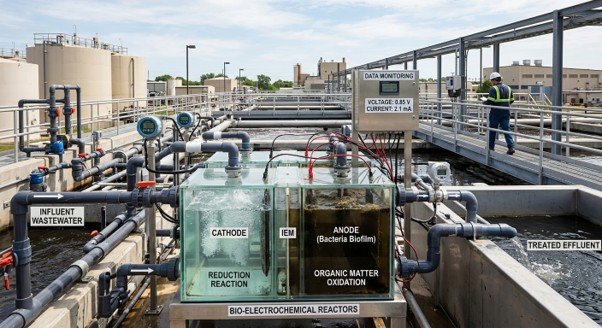
Conventional wastewater treatment is highly energy intensive. Bio-electrochemical technologies can generate electricity or produce hydrogen during the treatment process, transforming wastewater into a valuable resource and supporting circular economy objectives.
The potential to lower operating costs while recovering energy is driving increased interest from industrial users.
Advances in technology
Ongoing research is improving microbial fuel cells, microbial electrolysis cells and electrode materials, enhancing treatment performance, durability and energy conversion efficiency.
At the same time, automation, Internet of Things (IoT)-enabled monitoring and artificial intelligence (AI)-driven process optimisation are improving operational reliability by enabling real-time system control and more efficient plant operation.
Market challenges
Despite strong growth prospects, several challenges remain. High upfront capital costs continue to limit adoption, particularly among smaller facilities.
In addition, scaling laboratory-scale technologies for commercial deployment remains technically challenging. Improving long-term electrode performance, microbial stability and overall system optimisation will be essential to strengthen commercial competitiveness.
Emerging opportunities
Investment in smart water infrastructure is creating new opportunities for bio-electrochemical treatment technologies. Governments are increasingly supporting wastewater recycling, water reuse and carbon-neutral treatment through favourable environmental policies.
Developing economies are also expanding wastewater infrastructure to keep pace with industrial growth and urbanisation. As awareness of resource recovery increases, bio-electrochemical systems are expected to play a growing role in future wastewater treatment facilities.
Competitive landscape
Key companies operating in the market include:
• Cambrian Innovation
• Fluence Corporation (Emefcy)
• SUEZ Water Technologies & Solutions
• Veolia Environnement
• Xylem
• Paques
• Biowater Technology
• Aquatech International
• Aqua-Aerobic Systems
Outlook
The outlook for the bio-electrochemical wastewater treatment market remains positive as industries place greater emphasis on sustainability, resource efficiency and energy conservation.
Continued advances in microbial technologies, electrode materials, digital monitoring and process automation are expected to improve commercial viability further. As environmental regulations tighten and demand for circular economy solutions grows, bio-electrochemical wastewater treatment is likely to move from an emerging technology to a mainstream solution for industrial and municipal wastewater management, supporting sustained market growth through 2034.